

The ACB Group is one of the members of the Flemish Space Industry, the umbrella non-profit organisation overseeing Flanders Space.
As Sales Director at ACB Group, Jan De Maeyer is responsible for a large part of the European market, including the Benelux, Scandinavia, the United Kingdom and German-speaking countries.
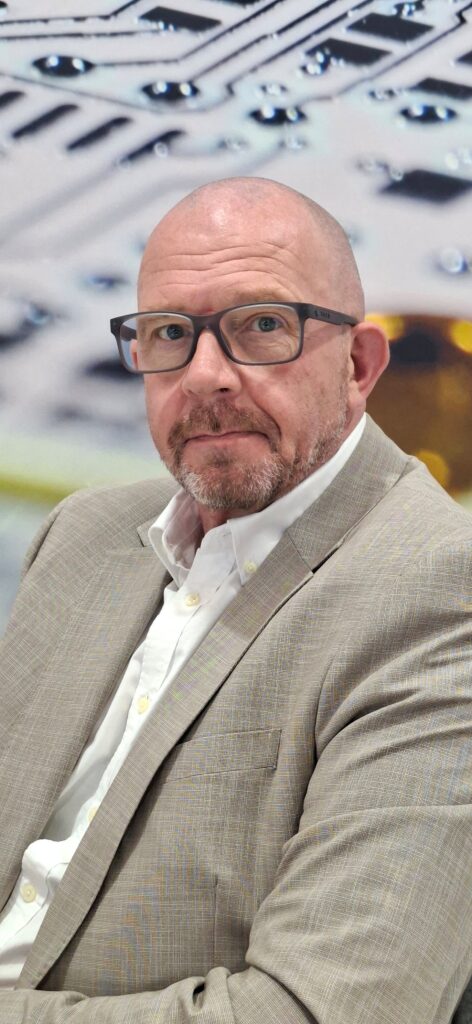
Based in Dendermonde, ACB develops and manufactures high-tech PCBs – Printed Circuit Boards – for demanding markets such as defence, aviation and space.
Since June, ACB has been part of the Italian Somacis Group, making the company part of a larger international player with operations in, amongst others, Italy, the United Kingdom, Switzerland, the United States, South Korea and China. ACB continues to operate as an independent entity within the group.
A basic component with a critical function
At first glance, a printed circuit board may seem like a relatively simple product, but nothing could be further from the truth. Modern PCBs can consist of dozens of layers, with extremely fine connections – both horizontal and vertical – ensuring that electronic components can communicate with one another. According to Jan, a standard PCB typically goes through 300 to 400 production steps; for the most complex products, this can rise to 600 to 700 steps.
That complexity is even greater in the aerospace sector. ACB belongs to a select group of European PCB manufacturers certified to produce to ESA specifications. As a result, PCBs from Dendermonde find their way into a wide range of aerospace applications.
ACB occupies a unique position within the space industry ecosystem. The company does not itself build satellites, launch vehicles or ground stations, but supplies essential core technology to companies that do. Whether a PCB ultimately ends up in a satellite, launch vehicle or ground station makes little difference to ACB’s fundamental role: ensuring that customers have the right, highly reliable electronic foundation for their application.
This position also means that ACB is primarily a technology enabler. The company does not necessarily determine the direction in which the space sector is evolving, but it must be technologically prepared to meet the sector’s ever-increasing demands.
‘Space quality’ as a benchmark
Space accounts for around 20 per cent of ACB’s turnover, but only a fraction of its production volume. After all, large production runs are rare. For some applications, ultimately only one PCB actually goes into space, supplemented by a few samples for testing.
The requirements, by contrast, are exceptionally high. According to Jan, aerospace is a fairly conservative market in technological terms: reliability is paramount, and new technology is only accepted once it has been thoroughly tested and proven. This translates into strict procedures, extensive documentation, testing and quality control.
For ACB, this was precisely one of the reasons for expanding into this market. Being able to demonstrate that you manufacture PCBs for satellites – where, once launched, you cannot simply send a technician to replace a faulty component – is strong evidence of technological competence and reliability.
Moreover, it is not just the space industry that benefits from this. The investments and process improvements required to meet space industry standards have raised the quality of the entire factory – and, consequently, the products for other markets – to a higher level.
Miniaturisation drives technological development
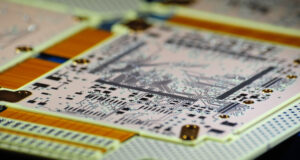 One of the most important technological trends is further miniaturisation. Semiconductors are becoming ever smaller and combining more and more functions into a single component. At the same time, hundreds of connections from such a component must be routed to other parts via an ever-smaller surface area.
This places ever-increasing demands on PCBs. More functions must be distributed across finer connections and multiple layers. In addition to conventional drilled connections, ACB therefore uses, amongst other things, so-called microvias or High Density Interconnect technology, in which lasers are used to create extremely small connections between different layers.
ACB was the first manufacturer to be certified by ESA to offer two levels of staggered microvias for space applications. In other markets, such as defence, the company now works with applications featuring up to five levels of stacked microvias.
This evolution shows no sign of stopping. Further miniaturisation means that ACB must continue to invest in production technology, processes and people.
Expertise is becoming an increasingly important challenge
It is precisely these people who present a major challenge. ACB is now the only remaining PCB manufacturer in the Benelux. Whilst this provides a strong market position, it also means that experienced specialists are almost impossible to find on the labour market.
New staff must therefore largely be trained in-house. In doing so, ACB strives to strike a balance between experienced staff – some of whom have been with the company for over thirty years – and a new generation that brings fresh knowledge and ideas.
This combination of experience and innovation is becoming increasingly important as technology grows more complex.
Growth, defence and new capacity challenges
The company is satisfied with the current scale of its space activities.
In addition, demand is currently rising sharply, particularly from the defence sector. ACB is therefore taking concrete steps to further expand its production capacity. This will enable the space sector to continue growing steadily in absolute terms as well.
Moreover, the dividing line between space and defence is becoming increasingly blurred. PCBs supplied by ACB to a space company may ultimately be used for both civil and defence-related applications.
In addition to capacity, the international supply chain is also posing an ever-greater challenge. Europe accounts for only a small proportion of the global PCB market, whilst the explosive demand from AI and data centres is absorbing a large share of the available capacity for certain base materials. For European manufacturers, this makes access to materials and long-term planning increasingly important.
Sustainability is also on the agenda
Another future challenge is sustainability. At present, it is difficult to fully recycle PCBs, mainly due to the combination of glass fibre and cured resins in the base material.
Nevertheless, things are changing in this area too. Among other things, ACB is in contact with a Belgian company that is experimenting with a new base material in which cellulose replaces glass fibre, with the aim of making PCBs more recyclable. The technology is still at an early stage, but it illustrates how even a relatively invisible component such as the PCB will have to evolve towards more sustainable solutions.
An enabling partner within Flanders Space
ACB deliberately does not see itself, within Flanders Space and the Flemish space industry, as the party that determines the direction of the space sector. Its expertise lies too specifically in PCB technology for that.
But that is precisely where its value to the ecosystem lies. As satellites, launchers, ground stations and other space systems evolve, the electronic components that make them possible must evolve alongside them. ACB aims to be technologically ready to support that next generation of applications.
The company ranks among the European leaders in terms of technology and consciously prioritises quality and reliability over the lowest price.
Or as Jan puts it himself: not everything that happens during a complex production process will always go one hundred per cent perfectly, but everything that leaves the factory must be one hundred per cent in order.
In the space industry, that is not an ambition, but an absolute necessity.
Want to find out more about the ACB Group? Visit: https://flandersspace.be/en/team/acb/

Leave a Reply
Your email is safe with us.